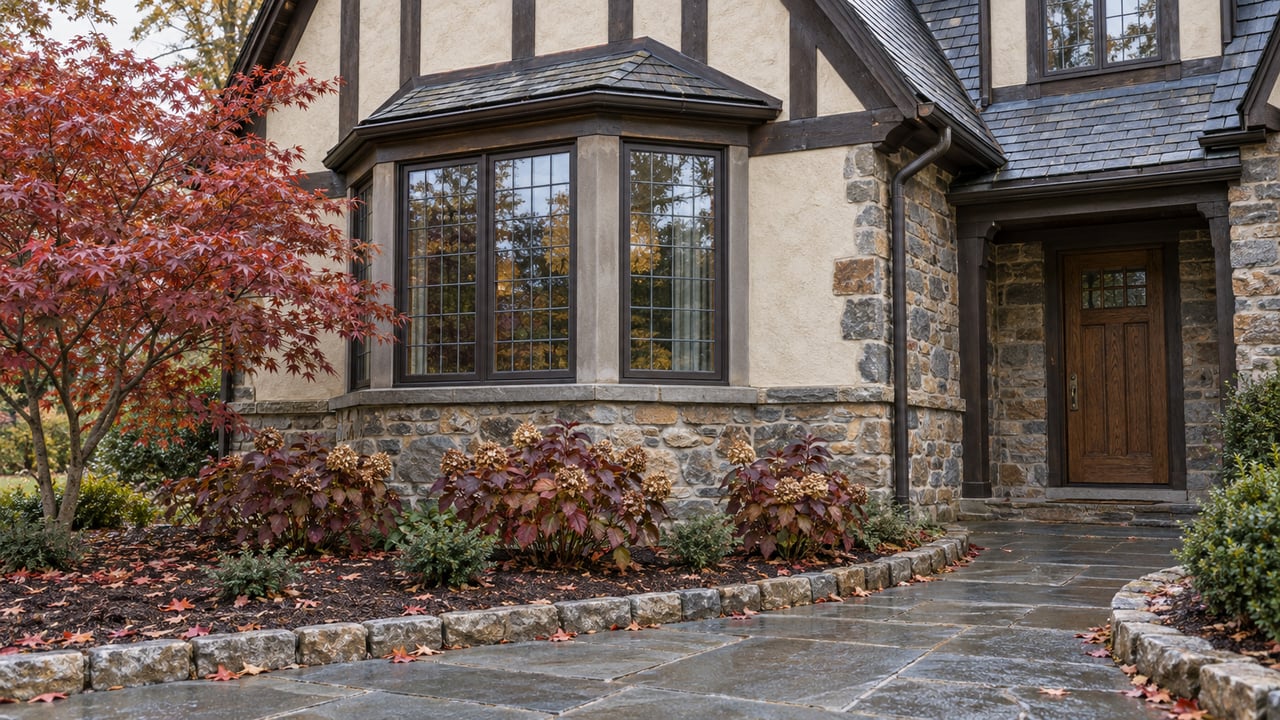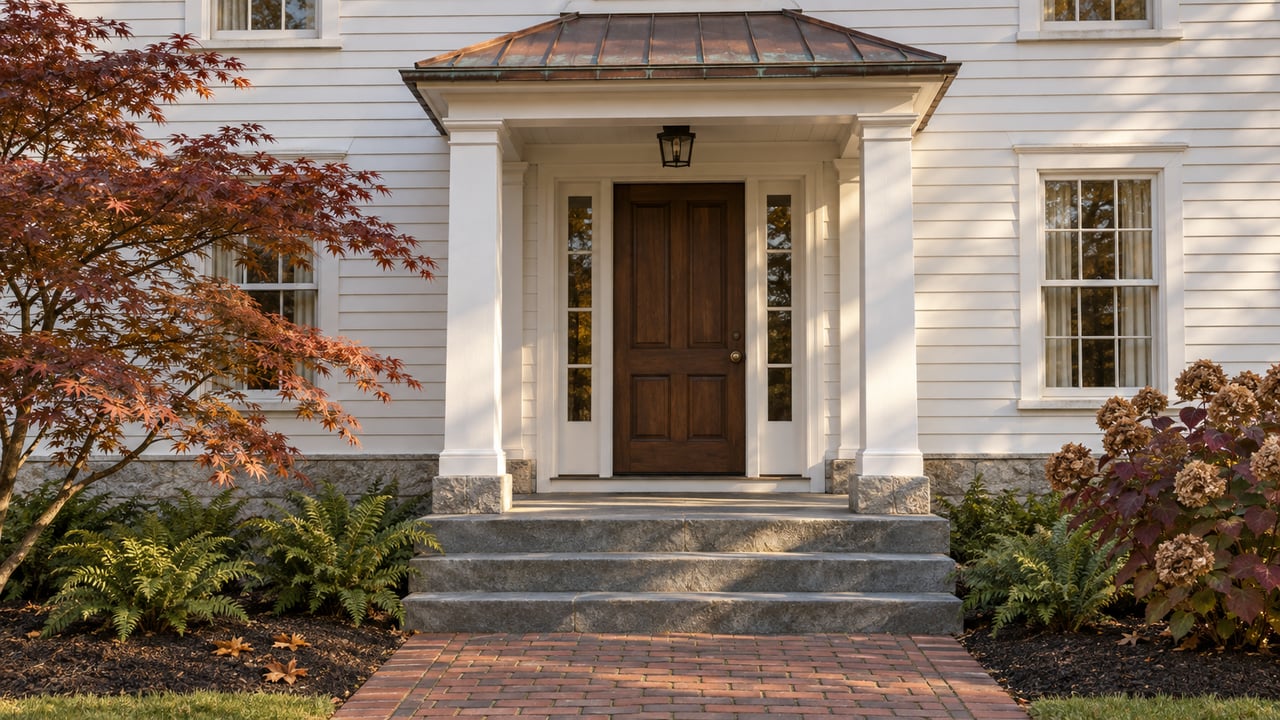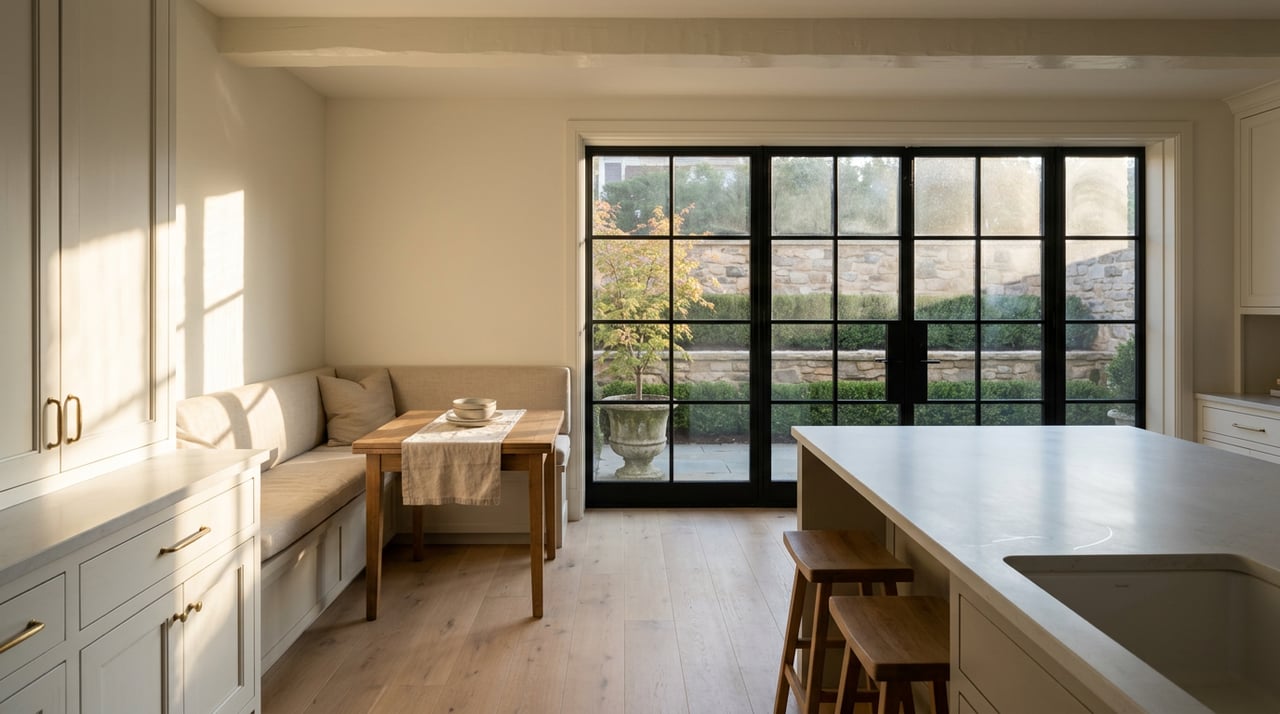
As Health & Life Magazine documented in its 2020 profile, a Ho-Ho-Kus couple who had bought a 1941 colonial in Cheelcroft a few years earlier took on the kind of project that scares off a lot of buyers eyeing the borough's historic section. Cheelcroft is a cluster of roughly fifty English Tudor-style homes built during and after the Great Depression by developer Harold W. Cheel, and this particular house was 2,000 square feet, on the smaller side even for the neighborhood. The couple's plan called for real work: new structural beams to open up load-bearing walls, closets removed to create flow, a powder room added on the lower level, and an enlarged breakfast nook with a new door out to the backyard. Outside, the cream-colored brick got a fresh coat and the shutters changed from green to black.
They hired Morpurgo Architects, a husband-and-wife firm based in Ho-Ho-Kus with more than three decades in business, and Ray Vetterlein Contracting out of Allendale to do the work. Here's the part that surprises most buyers who've heard the word "historic" attached to Cheelcroft: the project needed no special approval from the Ho-Ho-Kus Planning Board. The work preserved the home's historic character, and that was enough.
If you're shopping Cheelcroft, or you own one of its homes on Gilbert Road, Blauvelt Avenue, Glendon Road, or Sutton Drive and you're weighing a renovation before a sale, that single fact changes how you should budget your timeline and your expectations. A National or State Register listing sounds like a regulatory wall. In Ho-Ho-Kus, it mostly isn't one.
What a Register Listing Actually Controls
A Register listing recognizes the architectural and historical value of the Depression-era Tudor and colonial homes clustered in the triangle-shaped section along Route 502 near Sheridan Avenue. That listing matters, but it doesn't work the way people assume.
New Jersey's Register of Historic Places Act, passed in 1970, sets up a state review process, but that process is triggered by public undertakings, meaning projects that involve government agencies, public funding, or public property. Strictly private undertakings on privately owned homes aren't reviewable under that act at all. A homeowner repainting shutters or adding a breakfast nook isn't touching a lever the state cares about.
Contrast that with The Hermitage, the Gothic Revival house museum in Ho-Ho-Kus, which the New Jersey State Register review list records as listed since 1971. The Hermitage has drawn state preservation funding over the years, including a grant to the Friends of the Hermitage for an accessibility video for visitors, as the New Jersey Department of Community Affairs reported.
The Missing Piece Is a Local Ordinance, and Ho-Ho-Kus Hasn't Built One
The real gate that trips up historic-home renovations isn't the state Register. It's a locally adopted Historic Preservation Commission, and under New Jersey's Municipal Land Use Law, that commission only exists if a town's governing body passes an ordinance creating one. Nothing about a Register listing automatically brings a commission into being.
Some Bergen-area and North Jersey towns have done exactly that. Maplewood's municipal code includes a full historic preservation article that requires a certificate of appropriateness before most exterior changes in its historic districts. The City of Orange Township has a similar chapter empowering its Historic Preservation Commission to approve or deny demolition and major alteration permits. Jersey City runs a formal Certificate of Appropriateness and Certificate of No Effect process through its own Historic Preservation Commission, and Hoboken's commission meets monthly to review projects under its own ordinance.
A review of Ho-Ho-Kus's codified ordinances doesn't turn up a comparable chapter. That absence lines up with what happened on that 1941 Cheelcroft renovation: no local commission existed to trigger a review, so none happened. It's worth confirming directly with the borough's building department before you finalize plans, particularly if your project involves demolition, touches a designated landmark property, or draws on any state preservation grant, since those situations pull in the state-level review that private work generally avoids.
Here's how that plays out in practice, compared to a town that has adopted a strong local ordinance:
| Town with an adopted local HPC ordinance | Ho-Ho-Kus (Cheelcroft) | |
|---|---|---|
| Exterior paint or shutter color change | Often requires commission review | Not reviewable absent a local ordinance |
| Window or door replacement | Certificate of appropriateness typically required | Confirm with building department, not commission-reviewed by default |
| Demolition | Formal permit process through the commission | Falls back to standard borough and, if applicable, state review |
| Timeline impact | Weeks to months added for commission meetings | No added local review layer identified |
What This Means for Budget and Timeline
If you're buying in Cheelcroft expecting a Maplewood-style approval gauntlet before you can update a kitchen or repaint trim, you're likely pricing in delay that doesn't exist here. That's good news for the kind of cosmetic prep sellers use before listing, since staging, interior paint, and flooring work through a program like Compass Concierge rarely touch anything a commission would review even in towns that have one, and in Ho-Ho-Kus there's no evidence of that layer at all.
That said, "no mandatory local review" isn't the same as "no reason to be careful." The Register listing still means something to the next buyer. Homes that keep their historic character, the way the 1941 colonial did with its preserved massing and updated but sympathetic exterior, tend to hold the story that made a buyer want a Cheelcroft address in the first place. Following the Secretary of the Interior's Standards for rehabilitation, repairing rather than replacing original materials where practical, is a smart practice even without a legal requirement behind it.
A Register listing tells you the history is real. It doesn't tell you who has to sign off on your gutters.
If your renovation plans do involve public funding, loop in the borough early. Those are the scenarios where state-level review under the 1970 Register Act can actually apply, and finding that out after a contract is signed is a worse conversation than finding it out before.
FAQ
Does a National Register listing mean I can't change anything on a Cheelcroft home? Exterior work isn't subject to a binding local design review because Ho-Ho-Kus hasn't adopted a Historic Preservation Commission ordinance the way some neighboring towns have.
What if I want to apply for a state historic preservation grant for my home? That's one of the situations where public funding pulls your project into the state Register Act's review process, since grants and other public undertakings are treated differently than strictly private work. Preservation New Jersey's resources are a useful starting point if you're considering that route.
Should I still worry about resale value if I make major changes? Worth thinking through with your agent rather than assuming either extreme. Buyers drawn to Cheelcroft are often drawn specifically to the Tudor character, so changes that erase it can affect how the home shows even without a legal restriction attached.
Buying or selling a home in Cheelcroft or anywhere else in Ho-Ho-Kus comes with details like this that aren't on the listing sheet. If you're weighing a renovation, a sale, or just want a clear read on what a specific property actually requires, the Megan Fox Group can walk through it with you. Get a Free Home Valuation to start the conversation.
This article is general information, not legal, tax or financial advice. Consult a qualified professional about your situation.